Saturday, July 31, 2021

2021 Summer Solo Game - ImagiNations Dreadnought

It is time again for my summer solo gaming time. I've always wanted to do an ImagiNations type naval mini-campaign, where players take the role of naval leaders to plan, build, and train up their navies on a budget with a random time when the war begins. I usually propose it as an option when players vote for DANG, but they don't usually do very well.


Most of my summer solo games are centered around boardgames, since they are a little easier to setup/take down and don't require a lot of space. This year I've selected the old SPI boardgame Dreadnought as the basis for my solo mini-campaign. Mainly because the rules are pretty easy and will play quickly. While it is a boardgame, I could play it with miniatures (although it needs a hexgrid) and there is also a VASSAL module. So I have some flexibility with how I play the games.


My plan is to do that as my solo game using the Dreadnought Extended Campaign rules and the Additional Extended Campaign Ship Design rules from Moves No. 24.

For my game I will also use a randomly generated Admiralty Boards for each side that will set some basic plans for ship building and maintenance/training. The first boards get to do an initial build and then plan the annual shipbuilding for the remainder of their term. The boards will be replaced (rolled for again) every 5 years, which could change the buying strategy of the navy over time. The war will start at a random time and each side will see tensions rise or fall and what ships the other is building, which can also affect shipbuilding and maintenance plans.


OnCe the war begins things will shift to monthly turns. There will be random number and type of missions that the navies need to assign ships to, which will then turn into scenarios. The war will last 2 - 12 months (yes another random time) at which point a winner will be determined.


With all of my game ideas in place, I'm ready to start the mini-campaign. I rolled up the Admiralty Boards for the two belligerent nations, Nordland and Tierra del Sur (not the most imaginative names, but they will work for the game). 


Nordland's admirals believe the way to win is with fast, lightly armored battlecruiser type ships with medium-sized (10" - 12") guns and good light forces armed with torpedoes. Knowing that speed may cost more more, they have put in place an average maintenance and training program. Across the strait, Tierra del Sur's admirals have chosen heavily armored ships with weapons and speed set to keep the ships at a moderate cost. They also laid out extensive maintenance and training programs for an efficient naval force. 


My next step is to design and purchase the ships for each side. Then I will determine when the war starts, and set up the first missions. I should have that all in place for a later this week for International Naval Wargaming Day on August 6. For those of you that are unfamiliar with International Naval Wargaming Day, in 2017 David Manley, well know rule writer and naval gamer, kicked off the first International Naval Wargaming Day as a day to "Celebrate the birth of the father of naval wargaming, Fred T. Jane, by running or taking part in a game of your own!"


Here are a couple posters to help remind you about the event. 


Monday, July 5, 2021

Western Desert - What a Tanker

 I took advantage of the long weekend for U.S. Independence Day to have some friends over for a game on the lawn. This time around we decided to pull out some Western Desert 15mm World War 2 tanks and use the What a Tanker rules from Two Fat Lardies. Most people in the group had tanks to

A German Panzer III watches for the British

The What a Tanker rules some basic scenarios, but they are mainly just tank duels without any objectives. I prefer to have scenarios that are more than just shootouts, so I decided to add some ideas into the game. I borrowed some ideas from Mark Morin's blog (link to his blog post on something he did for Normandy) and I added my own to drive the game objectives. I based our scenario on Operation Crusader, the British offensive to relieve Tobruk in late 1941. This battle gives the British an interesting mix of tanks, which are still weaker than the Germans, and an objective to advance across and exit the area. 

A pair of fast Crusader tanks

For the game, I gave each side a number of buy points to purchase their tanks and other special actions (dust storms, artillery strikes, air strikes, etc.). Each side would earn victory points for destroying enemy tanks and the British would get points for exiting tanks off the map. We had six players and I thought the British should have an advantage, so we went with 4 British and 2 Germans (this was probably a mistake). The British had 2 Crusader Mk I tanks, an M3 Honey, and a Matilda II. The Germans started with a Panzer IIF and Panzer III F. The game map had several hills along with a couple depressions that were  minor obstacles for line of sight and shooting.  

M3 Honey on the move
When on the first round of the game the Panzer III hit a Crusader, reducing the tank's command dice, I thought it was going to be a tough road for the British. But things were downhill from there for he Germans. The other Crusader, the Honey and Matilda advanced on the Panzer II's position. The Honey ended up getting 3 hits on the little tank, putting it out of the game.

KO'ed Panzer II
The Germans brought on another Panzer III while the Crusader and Matilda advanced. 

Matilda on the move
The Crusader closed with the map edge and got into a close-range duel with the newly arrived Panzer III. Neither tank was able to hit the other hard enough to stop them. The Crusader eventually took advantage of the activation order to move off the map. The Honey was also able to get off the map. There were a lot of bad rolls for shooting and damage.
Close-range duel
On the other side of the map, the Crusader that had taken early damage was able to recover the Command die and moved to attack, while the Panzer III tried to take advantage of cover from the hill.
 
Crusader closes range
Die rolls on this side of the table were not great either, but the range kept closing and tanks tried to use to hill to their own advantage. 

Crusader driving over the hill
The British brought in replacement tanks for the ones that had exited the map. The new Crusader and Honey used their Fast attribute to quickly get into action. 

Honey and Crusader squeeze the Panzer III
The game ended shortly after the last picture. The Germans only lost the Panzer II, but other tanks had some damage. The British did not lose any tanks, although several were damaged, and exited several off the map. So while it seemed like a good close tank battle, the victory points were completely in the British favor.


So, while my basic scenario ideas seemed like they would work, they will need some tweaks and changes to really work.


After talking through the results a little, we decided to have another go with just a straight tank duel with Italian earlier British tanks. So it was an M11/39 and two M13/40s against an A-10, A-13, and Matilda.

A nice Italian M13/40
The die rolling was better and the results were a little more even this time, with each side losing several tanks.
M11/39 blows up

and an A-13 does the same
Overall, the rules are a fun diversion and the addition of some scenario rules will make game play a little more interesting. So I expect we will see the desert steel roll out again later this summer.

Saturday, June 26, 2021

German Räumboote and Italian MAS boats

The next additions for my Black Sea/Baltic Sea project are a pair of German Räumboote and four Italian MAS torpedo boats. First up, we'll look at the Räumboote.

Fresh from the yard, before I added some weathering

The German Räumboote, or R-boats, were motor minesweepers that were also used for convoy escort, coastal patrol, minelaying, and air-sea rescue.The Germans built over 300 of these vessels in several series during World War II. There weren't any major differences between the series,just some size and minor armament variations. Due to their general utility, they served in every theater including the Baltic, Mediterranean and the Black Sea. This makes them useful additions to a fleet for anyone wanting versatile ships that could be used in multiple areas. 


I picked up a pair of  Warlord Games Cruel Seas R-23 R-boats for my ships. These are early versions of the R-boat and later versions had a little more armament. The out-of-the-box model came with a forward firing 20mm gun and an aft 37mm. I considered adding another 20mm gun amidships, but there isn't really enough room on the model without some major work. 

Port side view with a little weathering
The hulls are one-piece resin and required some clean up. The weapons were straight out of box, as were the extra crew I added on one boat.
Starboard view
There are a number of camouflage patterns that can be used with these ships (just do a quick internet search to see what I mean). I decided to go with a splotch pattern camouflage, since it seemed easiest and seems pretty common. Overall, they turned out good and should be useful in games.


Next up are the Italian MAS, Motoscafo Armato Silurante (torpedo-armed motorboat), boats. These boats are similar to the British Vosper motor torpedo boats and smaller than the German S-boats. During World War II, the Italians sent a flotilla of these boats to the Black Sea and to fight on Lake Ladoga near Leningrad (today's St Petersburg). 

MAS lined up for inspection
These boats were fast (max speed 45 knots), but lightly armed with two 450mm torpedoes and an aft facing 20mm gun.
Arranged to show off all sides

These little boats only had modest success against the Russians. The boats in the Black Sea were eventually transferred to the Romanians. 

A close up view of the MAS

Like the R-boats, these are from Warlord Games. Unlike the R-boat, these boats are all metal and only have a few basic parts (hull, mast, and 20mm gun). So it is pretty easy to put together, but there was some clean up needed on all the parts. I think my paint job turned out as well as the ones on the Warlord website. Although I used a gray-blue color for the crew overalls, rather than the white used by Warlord. Thinking back on my old Navy days, I know that white is not a great color for a working uniform.


Overall, both sets of boats went together well and painted up nicely. They are good additions to the project. 

A before weathering photo on the ocean mat

Wednesday, June 2, 2021

Ersatz Enfilade - Ironclads Game

In normal years the Enfilade gaming convention would have happened over the U.S. Memorial Day weekend. But we still aren't in normal times and the 2021 Enfilade was moved to U.S. Labor Day weekend (September 3 - 5).  But with the first really good weather weekend coming up, I decided to have an Ersatz Enfilade game on my lawn.


Ersatz (ˈerˌzäts,ˈerˌsäts) Not real or genuine.


The lawn games from last year worked so well that I thought I would put up the pop-up canopy again for this game.


After talking with the group about what they wanted to play, we decided to do an American Civil War (ACW) naval action using the Ironclads rules. Kevin generously volunteered to run a hypothetical Confederate attack on Fort Pickens, which is the fort that was defending Pensacola Florida.

Target for Today - Fort Pickens

In addition to the fort, the Union would have a couple earthworks batteries and two Passaic class monitors. The fort and one battery defended the main ship channel, while the other battery covered a smaller channel. The monitors started on the land side of the fort near the main ship channel. The two ship channels were separated by a shallow bar, so the best entry points were through the channels. 

Union Monitors to help the defense

The Confederates had the Mobile squadron with the ironclads Nashville, Tennessee and Tuscaloosa and the wooden ships Gaines, Selma, and Morgan. 


Additionally, the Confederate force included the really hypothetical CSS North Carolina and CSS Stonewall ironclad cruisers. Historically, CSS North Carolina was seized by the British in October 1863, then purchased for the Royal Navy. CSS Stonewall was sold by the French to the Danes in 1863 and then to the Confederates in 1865, but it did not reach the Confederates before the end of the war; where it was taken over by the United States and later sold to Japan.

All the Confederates


CSS North Carolina and CSS Stonewall

The Confederates were split into two groups, the Mobile squadron and the hypothetical squadron. The Mobile squadron was set up in two parallel line-ahead formations, mainly due to the speed differences between all the ships. The slower ironclads (Tennessee and Tuscaloosa) were in a line closer to Fort Pickens and the faster ships (led by Nashville with the wooden ships following) in a line further away from the fort. The general idea was the faster ships could speed ahead to the main ship channel and keep firing on the fort, while the slower ironclads would take their shots and try to draw Union fire. This also allowed the ships to get on the map and engage with the fort fairly quickly. 


The hypothetical squadron planned to pass through the smaller ship channel and then make their way over to attack Fort Pickens. 


But, as with most plans, they weren't well explained and did not survive contact with the enemy. The mortars firing from Fort Pickens caused Nashville to turn out of line to avoid the shells. This in turn forced the following wooden ships to take evasive action to avoid collision. The outer line was never able to get reformed and the wooden ships were targets more than expected. The wooden ships turned away before they could get close to the main ship channel, while Nashville drove into the channel alone.

Confederate line in disorder
Trying to get the line back in order

The Union monitors moved slowly toward the main channel and decided to go after the closer Nashville, rather than the more distant hypothetical squadron. 

Union defenders head for the channel

The hypothetical squadron engaged the earthworks battery and silenced it. Then they turned toward Fort Pickens and began to engage the Union monitors at long range. 

Confederate heavies take on an earthworks battery

The guns on the monitors didn't quite have the range to damage the hypothetical squadron, so they held their fire for Nashville. But the Confederates were in range and caused a fire and magazine hit on one of the monitors.

Heavy action in the channel

With things very crowded in the main channel, the monitors went to ram Nashville, while Nashville tried to return the favor with a bow on bow ram.

Ramming and fires!

Damage was done to both sides, but everyone was still afloat. At this point we took a break to evaluate what had happened and decide if we wanted to continue.

Confederate decision point

Looking over the current situation; the main ship channel was blocked, two of the three Confederate wooden ships had taken heavy damage and Nashville was not in great shape. But the other Confederate ironclads only had minor damage and could still fight. On the Union side, one monitor was sinking, one fort face had taken heavy damage, and the other monitor had light damage.


After talking through the situation, things still seemed undecided. But we agreed the Confederates had an edge at this point with the heavy guns of the hypothetical squadron now able to be turned on the fort. Although it would be a near run thing for either side. 


With that, we wrapped up the game and spent the remaining time visiting and talking about current and future projects. Overall it was a fun game and day. It was good to see and game with people in person after a long winter.


Saturday, May 29, 2021

Crucible Crush Viet Cong

Back in April I posted about the Vietnam U.S. Army figures I got from Crucible Crush. Because I normally like to have forces for both sides of a battle, I ordered the four Viet Cong packs from the same Black Sun range.


There was no assembly needed for any of these figure. Although they needed a little more clean-up than the Americans. The figures are stout fellows with good detail, so even I could pick out the details when painting.


Like the Americans, most of the figures have packs and other gear. They have a mix of AK-47s, SKS carbines, SMGs, rifles, a RPD light machine gun, and a couple RPGs. I painted most up with the black uniform. The officer figure was done up in Khaki and I gave one other figure Khaki pants.

A group shot of the troops

While painting I had a little trouble getting some shadowing on the black uniforms and some of the faces didn't turn out as well as I hoped. They won't win in painting competitions, but on the game table they will look just fine. Here are some closer look photos.


As you can see from the photos, there are several figures that use the same pose but have different hats. That isn't really obvious when looking at the figures on the Crucible Crush website, but was more noticeable when I was painting them up.


Now I just need to pick up some jungle type terrain, which I can also use with my WWII Japanese and Australians.

Sunday, May 16, 2021

German Marinefährprahm

The Marinefährprahm (MFP) or naval ferry barge, was the largest landing craft operated by Germany's Kriegsmarine during World War II. These vessels were originally developed for the planned invasion of England. But once the invasion was cancelled, they found uses in other areas. MFPs served as transports, minelayers, escorts, and gunboats in the Mediterranean, Baltic and Black Seas as well as the English Channel and Norwegian coastal waters.

German Marinefährprahm (MFP) barges

There were four basic types, A, B, C, and D, with sub-variants for each of those. The size and cargo capacity increased with each type. Around 700 these vessels were completed by the war's end.
Most of the vessels were armed with 20mm and 37mm anti-aircraft guns, and some had a 75mm or 88mm gun. Those that were converted for escort and gunboat duty were more heavily armed with multiple 88mm or 105mm guns and heavier anti-aircraft guns. The Germans referred to these as Artilleriefährprahm (AFP), while Allied sources sometimes refer to this class of vessel as a "Flak Lighter" or "F-lighter." In addition to escort duties, these heavily armed versions were also used for shore bombardments, especially in the Black Sea and Baltic Sea.

MFP and AFP from a different angle

For the next installment in my Black Sea/Baltic Sea project, I put together some German MFPs and an AFP. Like my previous KFK project, these are not very sexy vessels, but they are useful and served everywhere. The MFPs are 3D printed (thanks to David Manley for pointing out the STL files). I decided to go with an unarmed print and then add guns from Warlords Games Cruel Seas Germans. My MFPs are lightly armed with only a twin 20mm on the gun platform. Looking back on it, I probably should have added a couple more weapons here and there. But these are mainly meant to be transports, so they will need an escort.

The lightly armed MFPs

The AFP started out as an Italian F-Lighter that I found cheap online. Since I already had the German weapons pack, I just substituted German guns for the Italian ones (I’m not positive, but I think the hulls for the German and Italian versions are exactly the same). My AFP is armed with 2 88mm guns, 2 quad-20mm guns, a twin 20mm, and a single 20mm. All of which should provide some nice firepower in the games.

The heavier AFP

I painted up all the barges in mid-gray, did some pin-washing to bring out a few details, and added some rust stains for weathering. The MFPs each got a little different color on the aft boat to make them easier to ID during games. 

MFP and AFP size comparison with the KFK (front left) and S-boat (front right)

Convoy run
Overall, I think these turned out fine and will look good on the tabletop. While they are slow (max speed of 10 knots), their shallow draft should make them tough targets for Soviets MTBs and the AFP has the firepower to help protect the group.

Sunday, May 2, 2021

German Kriegsfischkutters

Kriegsfischkutters (KFK) were small armed fishing boats used as auxiliary warships by the German navy during World War 2.

My newly completed Kriegsfischkutters
Similar to the British, before World War 2 the Germans created some standardized designs for their fishing fleet could be used by private operators. In return, the ships could be requisitioned by the navy during the war. One of the designs was the small Reichsfischkutter, which would then become the KFK during wartime. KFKs were used as escorts, submarine hunters, minesweepers, and general security duty.
Wartime photo of a KFK (from http://history-classics.de)

Over 600 of these vessels were completed before and during the war. They were typically armed with one 37mm gun, one 20mm gun, and depth charges. But they often mounted extra guns and I’ve seen photos where the forward 37mm was swapped for a quad 20mm. Because they served everywhere the Germans had ships, these little craft are really useful for European-based coastal forces games.


As part of my Black Sea/Baltic Sea project, I picked up a couple Warlord Games Cruel Seas KFKs to help escorts merchants.


The basic kit is nice and includes two KFKs. The hull and superstructure are resin and didn't need much clean-up work. Everything went together easily and fit well. The worst part of the kit was the weapons, some of which required a lot of cleaning and filing to look good. For all the Warlord kits I've gotten I've had to spend a lot of time cleaning up the weapons. For me, they have been the most troublesome part of the kit. That said, the end results generally look pretty good. So, I guess I shouldn't complain too much. 

The other side of the KFKs

For my models, I decided to use the standard layout and weapons fit. Warlord sells a weapons pack, so you could switch up the armament some and, for the really ambitious, you cut off the minesweeping paravanes and add another gun. 

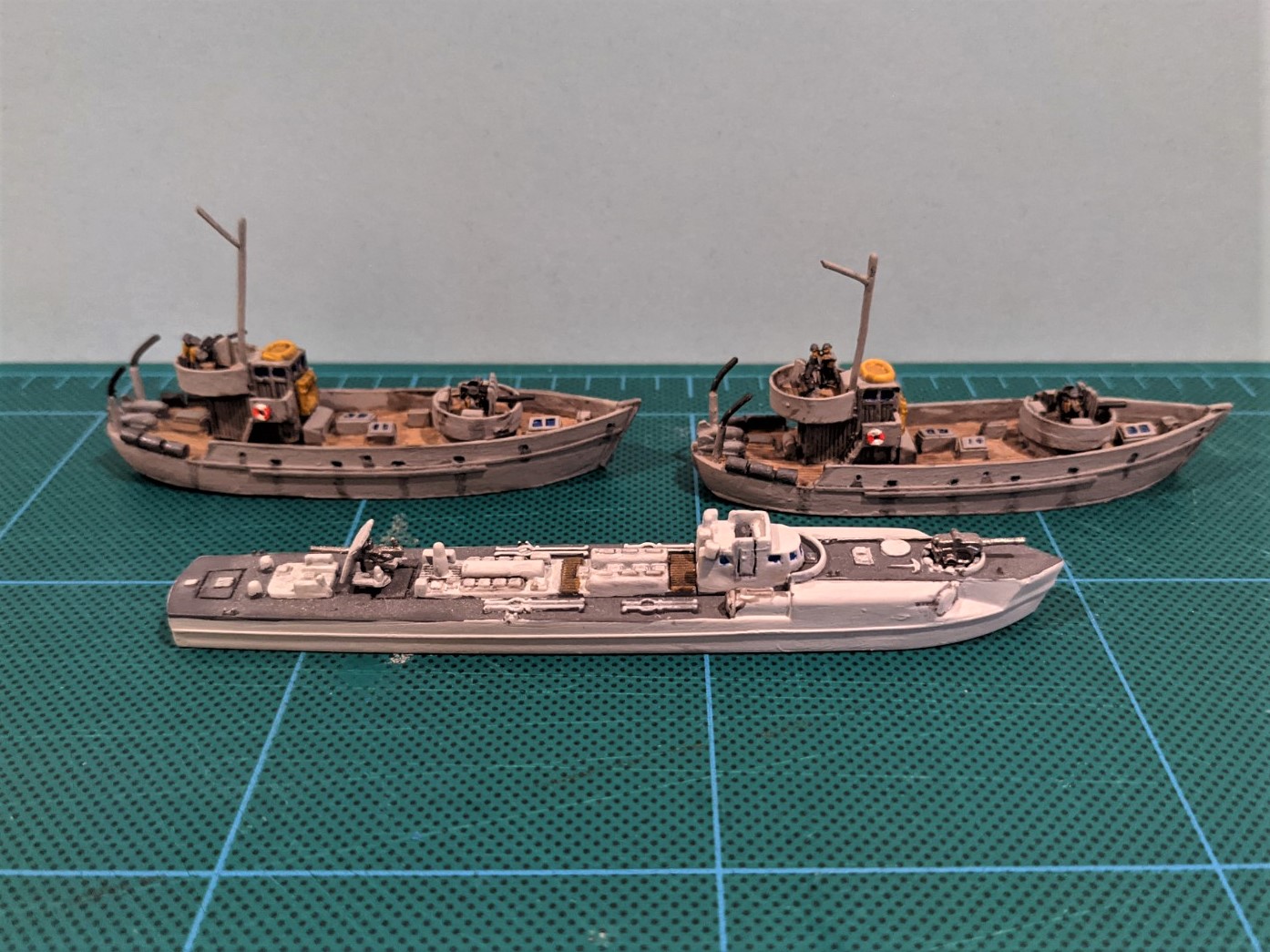
Size comparison with an S-boat

I painted up my ships in mid-gray with a light brown for the decks (the ship colors on the Warlord Games site look sort of blue-gray to me, which seems off). I then attempted to do some weathering on the ship. The decks and superstructure turned out okay (you can see the different planks on each). But I wonder if I was a little heavy with the colors on the side of the ship and for the water run-off holes. I touched this part up several times, but I'm still not sure it looks right. While I generally don't like my vehicles to be factory-fresh looking, I also don't care for heavy weathering. They will probably look fine on the gaming table. 

Overhead view showing the deck layout

Overall, I like the KFK kit. I would recommend them for anyone looking for a simple German ship to add to the 1/350 scale fleet. 

KFKs escorting a merchant